Brian Mumford, Friends Board Member
Historians often comment on the dearth of primary source material when writing about Henry Knox and his amazing feat in the winter of 1775 of transporting artillery from Fort Ticonderoga 300 miles to Boston to force the evacuation of the British. Knox did not keep a detailed daily journal and portions of what he did record were lost or destroyed. While leading the train of cannons on sleds through the wilderness in snow and freezing temperatures, his entries often were hurried and limited to recording his expenses or the distances he traveled between locations. The teamsters and boatmen hired to accompany him did not keep journals.
This lack of primary sources has resulted in historians having to make assumptions to fill in gaps where Knox left no particulars. Since some of their assumptions were varied, the written histories differ on many particulars. Some of the differences are whether Knox used oxen or horses, how and where he procured the sleds and oxen or horses, and the roles played in the procurement by various individuals such as General Phillip Schuyler or teamster George Palmer in Stillwater, and even the number of artillery pieces he brought to Washington.
The belief that Knox used oxen has been reenforced by the famous 1946 painting The Noble Train of Artillery by Tom Lovell. The painting portrays oxen pulling the 5,000-pound sleds. For the historical background of his painting, Lovell would have researched the same sparse primary source material that has confounded historians. In that material there is strong support for the position that the majority of Knox’s draught animals were, in fact, horses, which were arranged for by Schuyler. Oxen were used, albeit not many.
However, what is universally accepted is that in the winter of 1775 a 25-year-old bookseller traveled 300 miles from Boston to Fort Ticonderoga and through the winter snow brought back a large number of pieces of artillery weighing 120,000 pounds which resulted in thousands of British military and loyalists boarding ships in the harbor and evacuating Boston. Knox’s noble train of artillery presented the newly formed Colonial Army with its first victory of the War.
The question then becomes who was Henry Knox and how did he do it?
Henry Knox(1750-1806) was born in Boston, as a teenager worked as a clerk in a bookstore to support his family, and at age twenty-one opened his own bookshop. Henry was a voracious reader spending hours reading about military history.
In 1772, Knox became a member of the local militia who were resisting British authority. Following the
battles of Lexington and Concord on April 19, 1775, the militiamen surrounded Boston to effectively contain the garrisoned British troops within Boston. However, this siege became a stalemate because the British maintained control of Boston Harbor and were able to receive shipments from England of all necessary military and personal supplies. With the knowledge he had gained from books, Knox designed and oversaw construction of patriot siege fortifications. All the while, the British ships remained in the harbor safe in the fact that they were out of range of any colonial cannon fire.
General George Washington at the Siege of Boston
General George Washington arrived in Boston on July 3, 1775, to take command of a new Continental Army and, while inspecting the siege fortification work, he met with and was impressed by Knox. Soon after, Washington made Knox a colonel in the Continental Artillery.
The Need for Artillery
In developing a plan to bombard the fleet in the harbor, Knox focused on Dorchester Heights, a series of hills to the south of Boston. He concluded that with cannons positioned on the hills, the Continentals would be able to fire on the British fleet. The fleet, however, would not be able to return fire on the Patriots due to the high angle of the Heights.
Knox, aware that Fort Ticonderoga with its cache of artillery had recently been captured, approached Washington with the offer to travel to Fort Ticonderoga and bring back cannons. After weighing the chance of success of such a bold plan, Washington ordered Knox to the task.
Knox’s Campaign
On November 17, 1775, Knox set out for Ticonderoga with 42 militiamen. He stopped in Albany hoping to meet General Philip Schuyler, Commander of the Northern Department, however , Washington had sent Schuyler to Ticonderoga to assess and inventory the artillery and prepare for Knox.
Although Knox’s study of artillery had taught him the technical aspects of aiming and determining the range of cannons, he lacked Schuyler’s years of experience of managing long transports of artillery. Planning the Ticonderoga endeavor required assuring a reliable source of strong carriages or sleds capable of carrying heavy artillery as well as a chain of experienced teamsters and draught animals. In addition to managing and controlling draught animals, at that time teamsters were trained as carpenters and riggers experienced in moving heavy cargo and hauling it over rough terrain by assembling temporary systems of ropes, pulleys, levers, and cranes.
It was clear that Schuyler would remain involved in planning and coordinating. Schuyler, as Commander of the Northern Department of the Continental Army, was the primary person instrumental in securing the sleds and draught animals for Knox. By virtue of his position, he commanded the wagonmasters assigned to the Northern Department by the Quartermaster General. At the direction of Schuyler, wagonmasters were authorized to pay citizens a fee for providing the use of draught animals and wagons that the Continental Army required.
Traveling from Albany to Ticonderoga, Knox stopped at Stillwater where he discussed with teamster George Palmer arrangements for his providing sleds strong enough to carry the artillery to Boston and sufficient teams of oxen to pull them. The sleds were to be to be delivered at Fort George (now Lake George Village) when the snow fell.
Trail
Knox did not have to research a route over which to bring the cannons south from Fort Ticonderoga. He would travel a route over Lake Champlain, Lake George, and along the Hudson River, which had been used for hundreds of years by natives, missionaries, traders, as well as military, during various conflicts. Portage over rugged wagon trails was required to move boats and their cargo between the bodies of water. The transport was a constant challenge to the teamsters to protect the cargo and the animals.
The teamsters were not part of the military, but rather were hired among local civilians along with their equipment and draught animals. The teamsters walked along next to the carriages to provide assistance to the animals on rough wilderness terrain. When the crew had to move the cannon up or down a steep precipice, they used ropes and pulleys which they attached to trees to hoist a sled or carriage up a steep hill and also to control a sled or carriage descending a steep hill to prevent it from careening out of control.
Fort Ticonderoga
On December 5, Knox arrived at Fort Ticonderoga and began assessing the artillery. Prior to his arrival, General Schuyler had arranged for 29 pieces of artillery to be transported to Ticonderoga from the nearby fort at Crown Point, which also had been captured.
According to his various reports to Washington, Knox selected a total of either 55 or 59 brass and iron cannon. The selected artillery pieces included mortars, cannons, howitzers, and coehorns. All totaled, the selected artillery weighed 120,000 pounds.
Troops garrisoned at Ticonderoga assisted Knox in dismounting the 1,000-pound gun barrels from their wooden carriages using a tripod hoist (“gyn”). The artillery was loaded into carts and brought down the hill from the fort and loaded onto a large flat-bottom gondola at the shore of Lake Champlain. Once loaded, the gondola was sailed or rowed across the lake into the La Chute River, which connects the northern outlet of Lake George and the southern end of Lake Champlain .
La Chute Portage
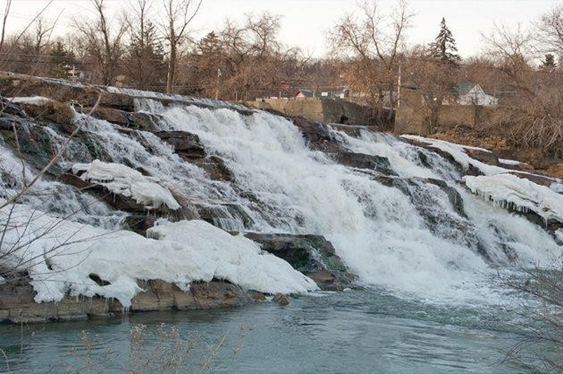
The La Chute River is a non-navigable four-mile series of rapids and waterfalls descending a course from Lake George to Lake Champlain which drops an elevation (220 feet) which is greater than Niagara Falls (167 feet.) A half-mile up the river is the lower falls and head of
navigation from Lake Champlain. There the cannons were off-loaded from the gondola onto oxen-drawn carts to begin the portage up the steep trail to Lake George.
The gondola returned to the fort to carry the next cannons over.
The artillery was hauled by oxen up the steep rough grade that ran along the La Chute River up to the northern landing of Lake George. The teamsters, with their ropes and pulleys, accompanied the oxen and cart on the climb up and around the waterfalls. Knox made no detailed record of the two-day effort, but it can be assumed that the training and experience of the teamsters was essential to the success of moving the 120,000
pounds of artillery up the steep portage trail to the landing.
Lake George Landing
La Chute River
Published with permission Tony Hall Lake George Mirror
At the Lake George landing there were three flat-bottom boats with professional boatmen to transport the guns down the lake, included a scow, a pettyaugre, and a batteau. The scow, which carried the heaviest artillery, was at first overloaded and sank in the shallow water near the landing. The crew managed to bail the boat out and rearrange the balance of the cargo. The three vessels were then ready to sail southward to Fort George.
Lake George
Lake George is 32 miles long with over 170 islands dotting the lake’s narrow surface. There are 176 miles of shoreline, including about 40 miles of island shoreline. This configuration of islands and shorelines creates a constant navigation hazard among countless fields of submerged rocks.
Knox boarded the fully loaded pettyaugre and set sail to lead the way down Lake George. With a fair wind, he reached Sabbath Day Point and went ashore having traveled 13 miles in six hours.
The batteau also came ashore for a short while and then went back on the water with plans to reach Fort George that night. Knox decided to switch to that boat. Strong winds blowing against them slowed their progress and they pulled into Bolton Landing for the night.
The scow, shortly after departure from the landing and a mile behind Knox, ran aground on submerged rocks 100 yards off shore. Fortunately, the boat had been moving slowly and there was no damage to the hull.
While the crew attempted to pull the boat off the rocks using a block and tackle, the rope broke. Word was sent back to the fort for more rope and additional crew. The next morning, with great effort, the scow was pulled off the rocks and continued its sail south. That evening while the crew was ashore, a strong wind and high waves swamped the scow and it foundered. The crew spent the next day and a half devising rigging to remove the cannons from the boat so it could be hauled ashore and bailed out. The boat was then refloated and the artillery cargo hoisted aboard.
Fort George
On the day the scow was refloated, Knox and his crew arrived at Fort George. Although his journal does not note when the other two boats arrived, entries in his journal show that on December 15 and 16 he paid the boatmen, so it is to be assumed that the boats and artillery had finally arrived at Fort George.
Knox now turned his attention to preparing to move the guns over land. He sent a message to Palmer in Stillwater to confirm that the sleds and draught animals, that he had ordered during his trip north, would “be ready by the first snow”.
By December 24 there had been no delivery by Palmer, and Knox headed off for Albany to seek assistance from Schuyler in arranging for teamsters. He walked in bitter cold temperatures and snow to Fort Miller, near Fort Edward, where William Duer, a local judge, welcomed Knox in his magnificent mansion. Over the years, Duer had become wealthy by providing the British navy with timber for ship masts. After a meal, Duer furnished Knox with a horse drawn sleigh for the remainder of his trip.
It is interesting to note that at this same location of Fort Miller within a year and a half—in July 1777—General Burgoyne would take his army of 7,000 across the Hudson River on a bridge of boats, as he advanced to Saratoga. He made Duer’s mansion—which the General referred to as a castle—his headquarters for a month. During that time, Duer was in Philadelphia serving in the Continental Congress.
Knox continued his trip, crossing the Hudson by ferry to Saratoga (now Schuylerville). During this segment of travel, Knox passed by the location where on October 17, 1777, Burgoyne would surrender his British troops and artillery. Today the location is the Saratoga Surrender Site.
Albany
Knox’s journal shows that once in Albany he met with Schuyler who called for Palmer to come from Stillwater to discuss his price for providing his sleds and oxen. When the negotiations broke down, Schuyler ordered his wagon masters to go out into the community and hire teamsters having the necessary sleds, and he specified horses rather than oxen. By December 31 the wagon masters presented Schuyler with names of the people who were sending their horses and sleds to Fort George.
As the artillery was being brought south from Fort George, the temperature dropped, and as a safeguard Knox had crews cut holes in the ice on the Hudson to bring water to the surface in an effort to thicken the frozen surface.
By January 5, 1776, all the artillery had reached Albany, and the process of bringing the guns across the river was underway. After a number of cannons were successfully brought across the Hudson, the massive 18-pounder went through the ice and sank in the river. After a full-day effort, the cannon was retrieved from the river.
In anticipation of sleds going through the ice, the teamsters carried sharp axes to cut the harness ropes to free the animals from a sled which was breaking the ice. In addition, prior to starting across the ice, heavy ropes were fastened to the cannons to aid in retrieving them if they were to fall into the river.
By January 9 all the cannons had been brought across the Hudson—not one piece of artillery had been lost during transport from Fort Ticonderoga.
Massachusetts
As Knox crossed the border into Massachusetts, his journal entries become even more sparse during the remainder of the journey.
Heading to Springfield, where Knox had arranged for an exchange of teamsters, the team labored through the freezing weather and snow-covered peaks and valleys in the forests of the Berkshires. All of the artillery was successfully brought over the mountains and then hauled onto Framingham, twenty miles west of Boston, where it was unloaded from the sleds. Knox continued on to Cambridge to report to Washington on January 18.
Dorchester Heights
Washington’s plan was to surprise the British by moving the cannons to the top of Dorchester Heights in one night. On May 4 more than 3,000 American troops using 400 oxen quietly maneuvered 24 pieces of artillery up Dorchester Heights with an elevation of 120 feet. They frantically constructed emplacements so that by morning they commanded an unimpeded field of fire over Boston and the British vessels in the harbor.
At morning, the British were amazed to find Dorchester Heights fully armed. Realizing their defenseless state, General William Howe ordered the army and fleet to prepare to depart. On March 17, 1776, 8,000 troops marched out of Boston and went aboard 120 ships with more than 20,000 British troops and their families, as well as 1,000 Loyalists. Knox’s in-laws, who were Loyalists, boarded a ship in the harbor.
Howe had made a successful agreement with Washington that the British would not set fire to Boston as they evacuated on the condition that the Americans would not bombard the fleet as it sailed from the harbor. The ships sailed from Boston Harbor to Nova Scotia, the British colony in Canada. Henry Knox’s supreme planning and efforts had given the newly created Colonial Army its first victory of the War.
After the Trail
Through the remainder of the War, Knox was in charge of all artillery of the Continental Army, and he was a constant advisor traveling with Washington. He was promoted to be the Army’s youngest major general and
played a key role in all of Washington’s battles including Washington’s crossing of the Delaware River, as well as the siege at Yorktown, which forced the British surrender.
After the War, Knox served as Secretary of War from 1785 to 1795, when he moved with his family to an estate in Maine which he called “Montpelier” in recognition of the support given by France during the War.
On October 25, 1806, at the age of 56, Knox died at his home after a short illness. He was buried at Montpelier with full military honors.
Works Consulted
Bell, J.L. “How Many Cannon Did Henry Knox Transport?” Boston 1775. Jan 26,
2017. https://boston1775.blogspot.com/2017/01/how-many-cannon-did-henry-knox-transport.html McCullough, David. 1776. Simon & Schuster, 2005.
Bellico, Russell P. Chronicles of Lake George Journey in War and Peace. Purple Mountain Press, 1995. Chadwick, Bruce. The First American Army. Sourcebooks, Inc, 2005.
Coffin H, Curtis W, and Curtis, J. Guns Over the Champlain Valley. The Countryman Press, 2005. Hazelgrove, William. Henry Knox’s Nobel Train. The Rowman & Littlefield Publishing Group, 2020. Drew, Bernard A. Henry Know and the Revolution Army War Trail. McFarland & Company, Inc., 2012
